Using badges in learning and development without the theatre
Build an L&D badge pilot around work transitions, assessed evidence, manager decisions and a six-month review, with concrete examples.
Verify Open Badge · Jul 3, 2026 · 7 min read
A team can issue hundreds of badges and still have no way to answer a manager's question: "Can this person lead the next incident review?" The useful unit for an L&D programme is a decision supported by observed work. A badge is a way to record and communicate that decision; it cannot make a weak assessment stronger.
Here is a small, testable design for a programme. The running example is incident-review facilitation, but the same approach works for customer support, equipment maintenance or data analysis.
Draw the progression before naming badges
Write down the work a person becomes able to do at each stage. For an incident-review pathway: first, attend a workshop; then co-lead a review with feedback; finally, lead independently on a real incident and agree follow-up actions. Those are three different claims. Only the latter two imply assessed capability.
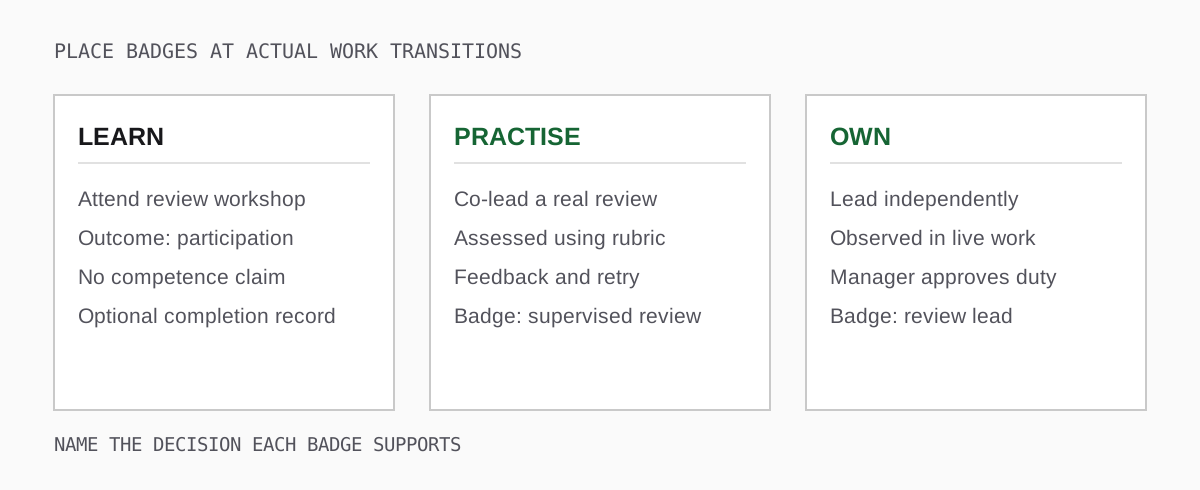
Ask a manager where the organisation makes an actual choice: assigning someone to facilitate a review, authorising on-call duty, or inviting them to the next level of training. Place the assessed badge at that boundary. If the only consequence of a badge is another badge, challenge whether you need it at all.
In the pilot brief, assign each transition a decision owner. For example: the incident lead owns the standard for independent facilitation; an experienced facilitator assesses the work; the rota manager decides who can take the next shift. These roles need not be the same person. Ask them to agree on the scope before badges are issued, so recipients do not discover later that the rota manager interprets the credential differently from the assessor.
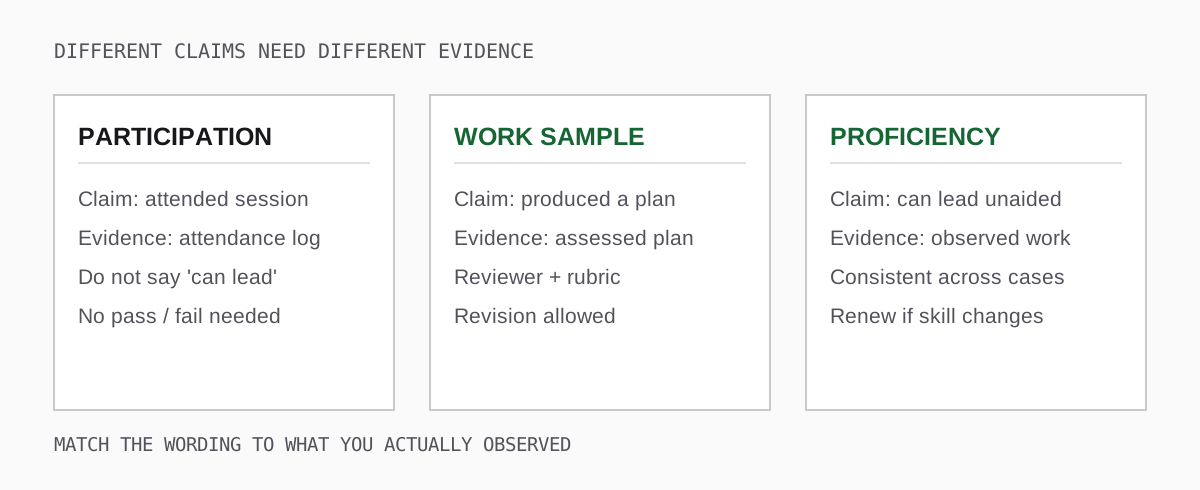
This does not prohibit participation records. Call them participation and keep them separate from credentials that claim competence. A workshop attendee may have learned a lot, but an attendance log is not evidence they can do a task alone.
Match each claim to evidence
Before asking a designer for artwork, make a three-column sheet: claim, evidence and who decides. "Attended" needs an attendance record. "Produced a safe incident-review report" needs the report and an assessment. "Can lead a review without supervision" needs observation in relevant work, ideally more than one case. Record which reviewer saw it and how disagreements or resubmissions are handled.
Some outcomes are hard to observe directly. Use a realistic simulation when live observation is unsafe or unavailable, and say that it was a simulation in the criteria. Do not silently present a simulated exercise as experience in a live incident. Where work contains customer or employee data, store the detailed report internally and expose only an approved summary of what was assessed.
Build an appeals or retry path. If a reviewer cannot explain why someone fell short, the criteria are not ready for a credential with staffing consequences.
For the first ten assessments, use two reviewers on a sample of submissions. Have them score independently, compare disagreements and tighten the rubric where their judgements diverge. This is more informative than asking whether they both "like" the finished badge. If learners do the same task in different teams, check that one team's routine access to high-profile projects is not being mistaken for higher capability. Offer an equivalent assessment route where necessary, and tell participants in advance what evidence they are expected to provide.
Publish a small rubric and a real pass rule
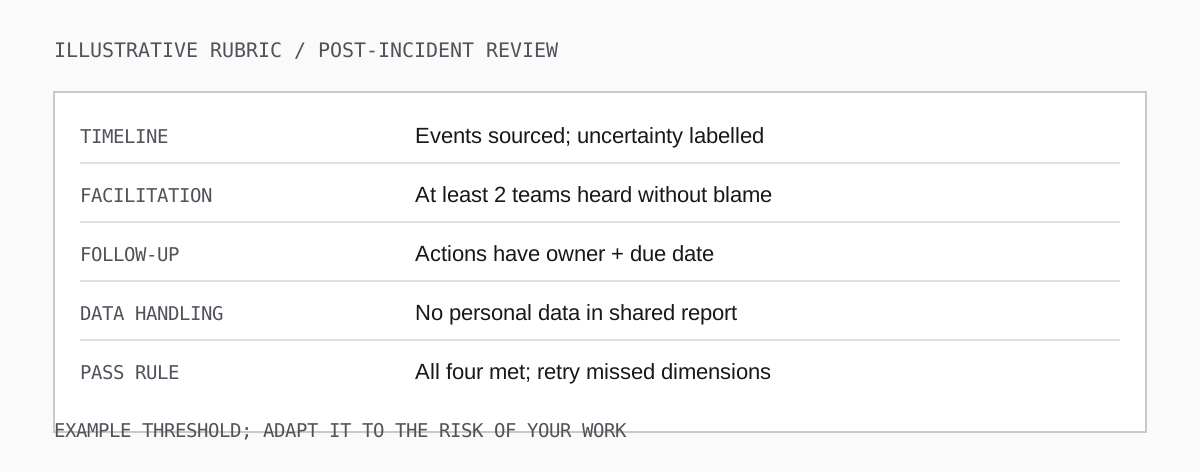
For the incident-review badge, an illustrative rubric has four dimensions: an evidence-backed timeline, blame-free facilitation across teams, follow-up actions with owners and dates, and safe handling of personal data. The learner must meet every dimension; a perfect timeline cannot compensate for publishing private employee information. State who judges each dimension and what a retry looks like.
Make the retry specific. Someone who handled private data correctly but failed to assign owners to follow-up tasks should redo that part, not sit through the introductory workshop again. Decide whether a second observation is needed to demonstrate the improvement. Store the assessed artefact or reviewer notes only for the period your programme actually needs them, with access appropriate to the material. A public badge can say that an approved review was assessed without exposing the incident report itself.
A two-case requirement is useful only if you can explain why two cases give sufficient coverage. For high-risk work, use a stronger threshold and review it with the people who own the risk. Freeze or version the rubric used for each cohort. If the 2027 badge requires a different capability, keep the 2026 criteria readable for people who earned it then. How to design understandable badges goes deeper on naming and criteria.
Give managers a decision-ready view
Most managers will see a badge name and one sentence, not its full credential JSON. Show the task, scope, assessment and limitation: "Can lead a post-incident review with a peer; observed on two real cases; current rota policy still applies." That makes the badge relevant to an assignment without pretending it alone authorises every future case.
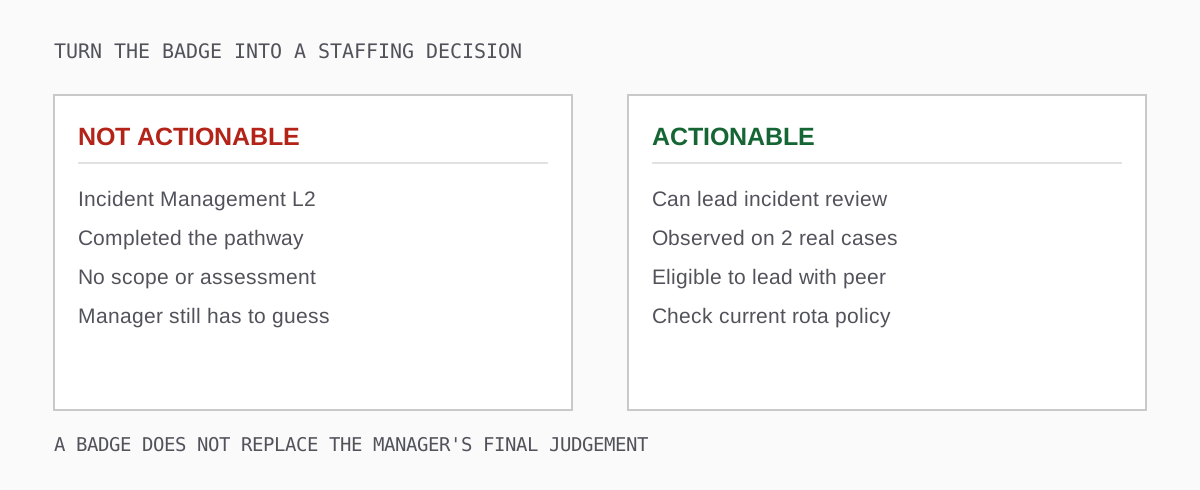
Decide in advance what the badge changes: eligibility to be considered for work, a prerequisite for a programme, or evidence during a staffing conversation. Document who makes the final call. If the skill is safety-critical, a current authorisation or supervisor sign-off may still be required even when a past achievement credential validates perfectly.
Do not use badge counts as a shortcut for promotion. A manager needs evidence of performance in the new role, not a leaderboard of course completions.
Tell learners the same thing in the invitation. Specify whether the badge records a completed assessment, contributes to eligibility for a role, or is required by a separate policy. Do not market it as a promotion guarantee if the manager still needs a vacancy, an interview or a safety sign-off. Clear expectations make a badge more likely to be used and reduce pressure on assessors to pass everyone.
Decide when the claim needs refreshing
Expire a credential when its current meaning depends on periodic reassessment: changed regulations, fast-moving tools, or safety procedures. Specify the trigger, renewal evidence and grace period before the first credential goes out. Do not set a date solely to drive repeat enrolment.
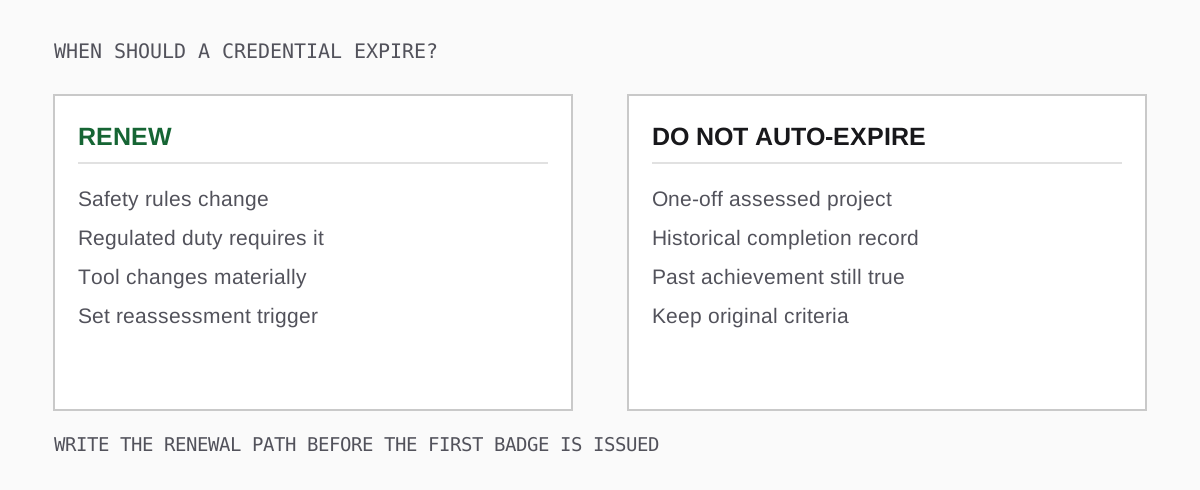
A completed project remains a completed project. A person may still need a separate current authorisation before performing a duty. Keep those records distinct. Retiring the badge definition so that no new badges are issued also does not revoke credentials that existing learners earned. The programme operations guide covers these two lifecycles.
Turn the assessment into something a recipient can keep
After a learner passes, issue a credential with the assessed capability as its name, an issuer the recipient can identify, the date of the achievement and criteria tied to the rubric version they actually completed. The Open Badges 3.0 specification describes the achievement, criteria and recipient information an interoperable badge can carry. If the claim is limited to supervised practice, put that limitation in the description. Keep generic criteria and the meaning of the badge at a stable URL; do not put the private incident report on that page. Give the learner the original signed export as well as any visual badge or share link.
Use a small acceptance test before the first cohort receives anything. Ask a manager who did not design the programme to read one example credential and answer: what can this employee do, under what conditions, and how was that assessed? Then ask a learner to download it without an administrator's help. If either person cannot complete their part, fix the delivery and wording before you roll out. A credential that depends on someone explaining an internal course code in person will be hard to use after the learner changes teams or employers.
Finally, agree on correction procedures. Misspelt recipient information, incorrect assessment dates and a failed signature do not call for the same remedy. Decide who can correct the underlying record, when you will issue a replacement credential, and how you will explain a revoked or superseded one to its holder. Keep the audit trail private and proportionate to the decision the badge supports.
Pilot three transitions and evaluate six months later
Verify the pilot's exported badges
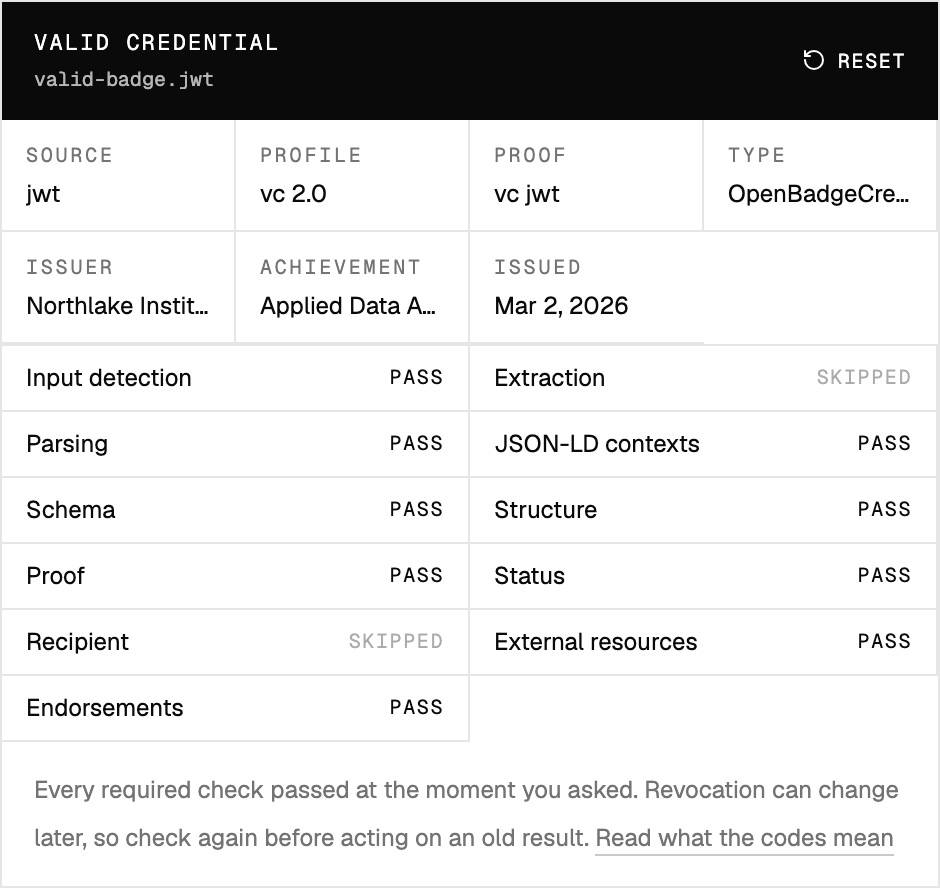
Select three assessed transitions, each tied to a real decision and a named owner. For the first cohort, export one credential through the learner's flow and run it through an independent validator. Repeat with an older signing key after any key rotation, and test revocation if you offer it. If the file fails outside your own platform, recipients will struggle to use it when they leave.
Measure whether the badges changed decisions
Measure the funnel eligible → assessed → passed → used in a decision. Count people who do not reach assessment and ask why; high issuance alone cannot tell you whether learning transferred to work. Sample actual staffing decisions with managers and ask whether they consulted the credential, understood its limits and changed their decision. Ask recipients whether they could retrieve their original credential and explain it to someone outside the organisation. Share rate is optional: some useful internal qualifications should never be public.
Before the pilot, agree on a baseline and a question that could change your plan. For example, compare the number of new facilitators taking on incident reviews before and after the programme, while accounting for how many opportunities were available in each period. If only a few people are assessed, speak to them and their managers instead of presenting percentages as strong evidence. If many pass but assignments do not change, investigate whether managers know the badge exists, whether the task is available, or whether the assessment is trusted. Those are different problems; issuing more badges would solve none of them.
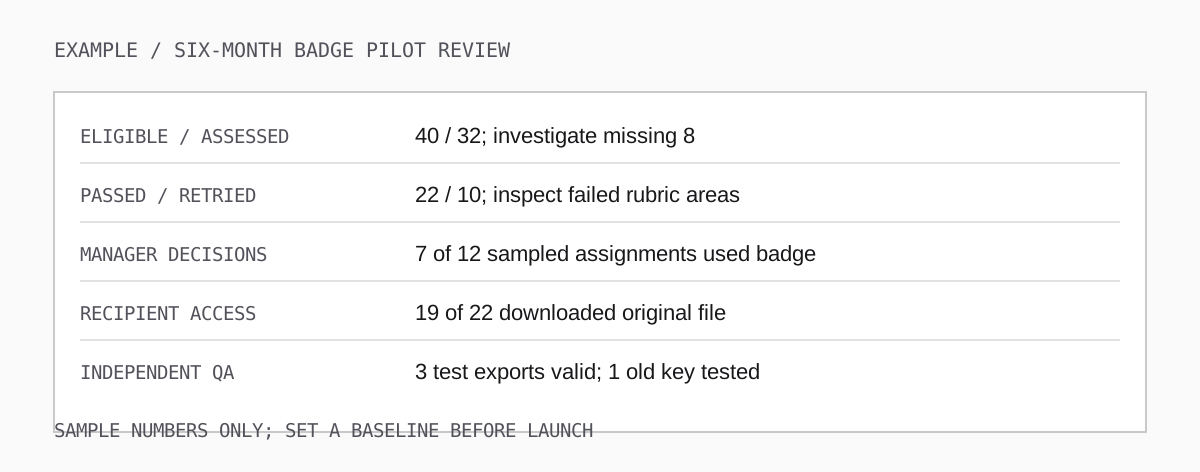
The numbers in the example are illustrative, not a benchmark. Set a baseline before launch, review the three badges with managers after six months, and drop any claim nobody uses rather than multiplying catalogue entries. If a badge helps people take on better work and remains verifiable when they move on, it has earned its place.